
You do not start Googling “pipe bursting vs pipe lining” unless someone has just told you that your sewer line is in serious trouble. Maybe you have had sewage back up in a shower, or every drain in the house is suddenly slow, and the plumber mentioned something about a broken main line. Now you are looking at two unfamiliar trenchless options and a big price tag, and you do not want to guess wrong.
We understand how that feels because we talk to Henderson and Las Vegas Valley homeowners in this position every week. Someone runs a camera through the line, you see roots, cracks, or standing water on the screen, and then you are handed a quote for either pipe bursting or pipe lining without much explanation. You are left wondering which method you really need, whether your yard will have to be torn up, and how long any of this will actually last in our desert conditions.
At Atlas Plumbing, we have been repairing and replacing sewer lines across Southern Nevada since 1980. A certified master plumber leads every project, and our team has decades of hands-on experience with both pipe bursting and pipe lining in local soil, under local streets, and under the specific plumbing codes that apply here. In this guide, we will walk you through how each method actually works, where each one makes sense, and how we decide what your sewer actually needs, so you can move forward with a clear head instead of crossed fingers.
Why You Are Hearing About Pipe Bursting & Pipe Lining Now
For most people, the first time they hear the words “pipe bursting” or “pipe lining” is right after a serious sewer problem. You might have had repeated backups even after snaking, a foul smell outside, or gurgling in multiple fixtures. A plumber or home warranty company sends someone out, they run a camera from a cleanout or through a roof vent, and suddenly you are looking at video of cracked, offset, or root-choked pipe that has probably been deteriorating for years.
At that point, you often hear the term “trenchless” as the supposedly easy, modern answer. In reality, trenchless sewer repair is an umbrella category. Pipe bursting and pipe lining are two very different ways to deal with a failing main sewer line. Both can reduce surface excavation compared to digging the entire run, and both can be valuable tools when used in the right situation, but they are not interchangeable and they do not solve the same problems in the same way.
What makes this confusing is that you are being asked to choose between methods on a high dollar repair while you are under pressure to get your home back to normal. You might be worried about the cost, how much of your yard or driveway will be destroyed, whether the work will pass inspection, and how long the fix will hold up in our hot, dry climate with hard water. Our job in this article is to take you behind the curtain so you can understand why a plumber might recommend one method or the other, and how we decide what your specific sewer line actually needs.
How Trenchless Sewer Repair Actually Works in Southern Nevada
Trenchless sewer repair simply means repairing or replacing a buried sewer pipe by using the existing path of the line, with minimal surface digging. Instead of digging a long open trench from your home to the street, we access the pipe through one or more small pits or existing cleanouts. We work inside the old pipe route to install a new pipe or liner, then reconnect to your plumbing and the city main according to code.
The starting point for any serious trenchless discussion is a thorough sewer camera inspection. We send a camera through the entire length of the line, record video, and use a locating device on the surface to mark depth and path at key points. In Southern Nevada, this is especially important because older homes may have clay or cast iron lines, while newer homes usually have ABS or PVC. Our desert soils can shift, and our hard water can create heavy scale inside older cast iron. All of that affects whether a trenchless method will perform well or struggle.
Trenchless does not mean “no digging” and it does not always mean “cheaper than excavation.” If your sewer line runs shallow through a dirt yard with easy access, traditional excavation may be straightforward and cost effective. On the other hand, if the line runs under a stamped concrete driveway or a pool deck, trenchless can save a lot of disruption. There are also clear limits. Serious bellies where the pipe holds water, sections that have fully collapsed, or lines that dip and rise unpredictably can rule out certain trenchless options. Our in-depth knowledge of Southern Nevada plumbing codes, soil conditions, and regional plumbing systems helps us sort through those variables before we suggest any method.
What Is Pipe Bursting and When Does It Make Sense?
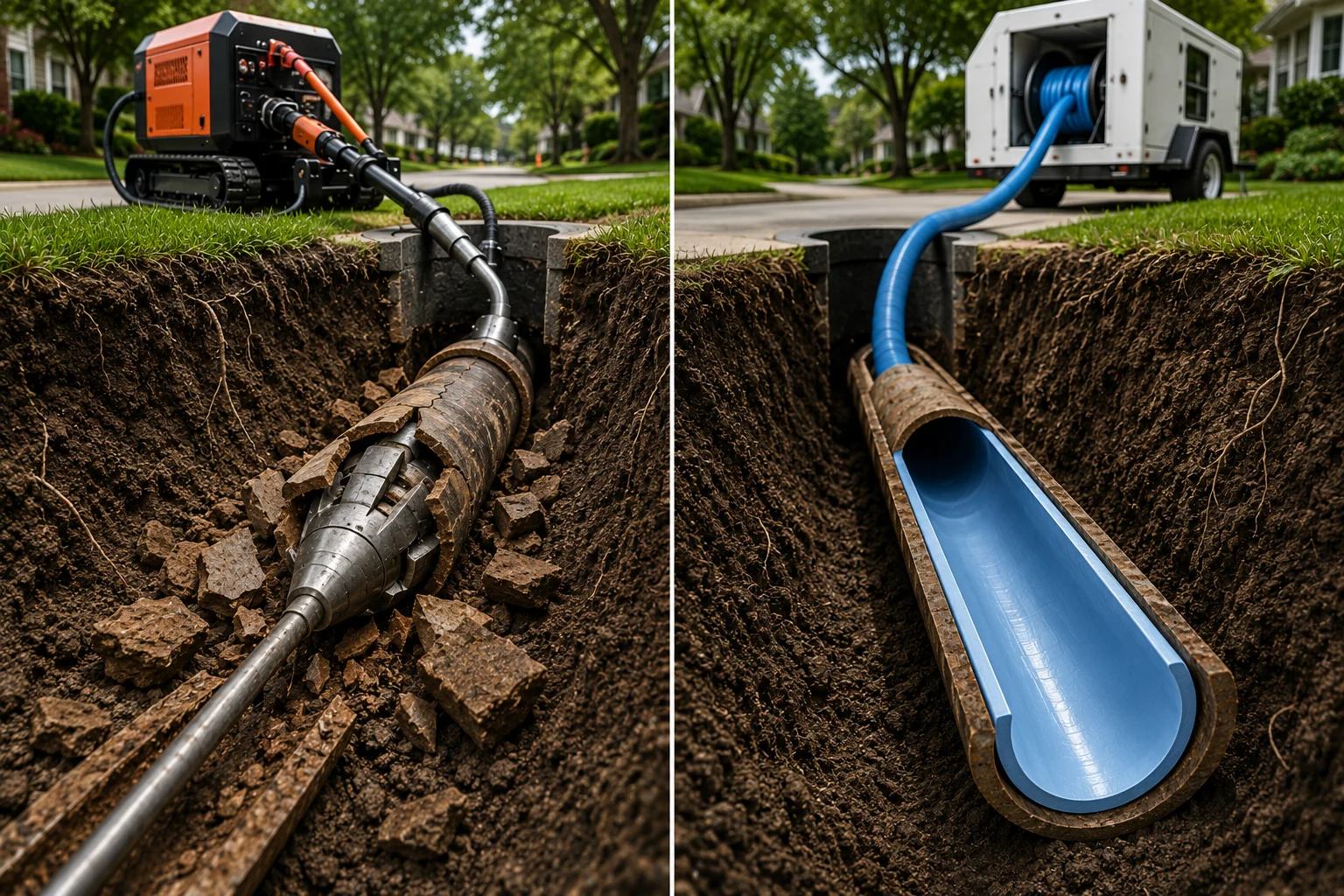
Pipe bursting is a method of replacing an old sewer pipe by breaking it apart from the inside and pulling a new pipe into the same path. In a typical residential setup, we dig a small entry pit near your home and an exit pit further down the line, often near the property line or sidewalk. A steel cable or rod is fed through the old pipe from one pit to the other, then a cone-shaped bursting head is attached at one end with the new HDPE or PVC pipe connected directly behind it.
During the bursting process, the bursting head is pulled through the old pipe. As it moves, it breaks the old pipe into fragments and pushes those fragments into the surrounding soil, slightly expanding the tunnel. The new pipe is pulled in right behind the head so that when the process is complete, you have a continuous, jointless pipe in the same alignment as the original. Because the new pipe is typically corrosion resistant and joint free, it usually resists roots and leaks much better than older jointed clay or cast iron pipe.
Pipe bursting tends to make the most sense on longer, reasonably straight runs where the old pipe is badly cracked, heavily root infested, or severely worn, but has a known path and adequate slope. For example, many Henderson homes built several decades ago have clay or cast iron sewer lines that run from the house to the street under yards or driveways. When those lines are in rough shape along most of their length, pipe bursting often lets us replace the entire run without trenching the full distance.
Local factors matter a lot. Our desert soils can be compact in some areas and looser in others, and there may be other utilities such as gas, water, or electrical conduits crossing the sewer line. Before recommending bursting, our certified master plumber reviews camera and locating data to confirm that the path is clear enough and that pits can be placed safely. We also look at depth and proximity to foundations, walls, or other structures, since the bursting process should not be used where expanding the tunnel could damage nearby infrastructure. Our familiarity with local permit and inspection expectations helps make sure the plan we design can be approved without surprises.
When all of those conditions line up, pipe bursting often gives homeowners a full size replacement pipe with minimal surface disturbance and a long service life. It is particularly strong when the existing pipe is too compromised to hold a liner but still open enough for the bursting head and cable to pass through. It is not a cure all, but used in the right scenario, it can be a very effective way to renew a failing sewer line.
What Is Pipe Lining and When Does It Make Sense?
Pipe lining, often called cured in place pipe (CIPP), repairs a sewer line by creating a new pipe inside the old one. Instead of breaking the old pipe apart, we clean it thoroughly, then insert a flexible liner that has been saturated with a special resin. This liner is either pulled into place or inverted using air or water so it presses against the inside of the existing pipe along the damaged section.
Once the liner is in position, the resin must cure so it hardens into a solid, smooth pipe. Curing can be done with time at ambient temperature, with hot water, or with UV light depending on the system. After curing, the liner holds its shape and adheres to the host pipe, forming a new pipe within the old one. Openings to other pipes, such as branch lines, are then carefully reopened from the inside. The end result is a continuous, corrosion resistant passage that seals cracks and blocks future root intrusion along the lined segment.
Pipe lining works best when the existing pipe is still mostly circular, has not shifted severely, and does not have large bellies full of standing water. Typical good candidates are lines with root intrusion through joints, moderate cracking, or some corrosion, but where the overall alignment and slope are intact. Lining shines in situations where excavation would be particularly disruptive, such as under a driveway, patio, mature landscaping, or structures that would be costly to remove and replace.
One critical point that does not get explained enough is diameter reduction. The liner takes up some space inside the host pipe. In a 4 inch residential sewer line, for example, the liner will usually leave a slightly smaller finished internal diameter. If the line is sized correctly and the liner is installed properly, that reduction is generally acceptable and flow is improved by the smoother surface. However, in marginally sized lines or ones that already have flow issues, that change needs to be considered carefully. Proper cleaning and descaling before lining are also essential in older cast iron, especially with the mineral buildup we see from hard water in the Las Vegas Valley.
There are also regulatory and physical limits. Lining across severe bellies where water already sits, or across fully collapsed sections, tends to fail because the liner cannot form a solid, well supported pipe. Local plumbing codes may restrict how and where you can line into the city main, and they may require specific cleanouts and transitions to be accessible for inspection. Our team’s understanding of Southern Nevada codes and typical inspector expectations helps us avoid recommending lining where it is likely to be rejected or perform poorly over time.
Pipe Bursting vs Pipe Lining: The Tradeoffs That Actually Matter
Once you understand the basics of each method, the next step is to compare them on the points that actually affect your home and wallet. The right choice is not about which buzzword sounds more advanced. It is about how each method responds to the specific condition of your sewer line, your property layout, and local code requirements.
In terms of yard disruption, both methods usually require at least one small pit and often two. Pipe bursting typically needs entry and exit pits at each end of the section being replaced, which can be an issue if access at one end is tight. Pipe lining usually relies more on existing access points or a single pit, which can be helpful under driveways or patios. However, lining requires thorough cleaning equipment access, which sometimes means additional entry points anyway.
There are several other core tradeoffs to consider:
- Pipe condition and failure type. Bursting is generally better for long runs of badly damaged, cracked, or root-invaded pipe where the alignment is still usable but the material is in poor shape. Lining is often better where the structure is mostly intact, with cracks or joints letting roots in, and where support from the host pipe is still available.
- Pipe diameter and flow. Bursting usually gives you a full diameter new pipe and in some cases can even upsize slightly if codes allow. Lining slightly reduces internal diameter, which is usually fine but can be a concern if the original line was marginal or if there are a lot of fixtures upstream.
- Nearby utilities and structures. Bursting puts outward pressure on the old pipe and surrounding soil as the head moves. In tightly packed utility corridors or close to fragile structures, that may not be appropriate. Lining leaves the pipe in place, so it can be gentler on nearby utilities when the host pipe is stable.
- Inspection and code considerations. Local codes influence where you can transition from old to new pipe, how close cleanouts must be, and whether certain types of liners are allowed into public mains. Bursting that replaces the entire run from house to property line can simplify some of these transitions. Lining may be limited to private portions of the line and require precise documentation for inspectors.
- Future maintenance. A new pipe from bursting is usually straightforward to jet and maintain like any modern sewer line. Lined pipes can also be cleaned, but aggressive cutting tools must be used carefully to avoid damaging the liner. Access to cleanouts and the quality of the original cleaning and prep affect how easy maintenance will be.
Cost is a common concern, and it is rarely as simple as “trenchless is cheaper.” The price of each method depends on line length, depth, number of pits, obstacles such as concrete or landscaping, and how much prep is required. Sometimes a straightforward excavation on a short, shallow run in bare dirt is more cost effective. Other times, replacing a long, deep line under a driveway with bursting pulls ahead once you factor in concrete demolition and replacement. At Atlas Plumbing, we lay out these cost drivers clearly with honest, transparent pricing so you can see why one option may be more or less expensive for your particular property.
Because we have handled many large and complex sewer projects in Southern Nevada, we focus on explaining these tradeoffs in plain language instead of steering every job into one method just because we own a certain machine. That comparison, grounded in what your camera inspection actually shows, is what should drive the decision for your home.
Common Myths About Trenchless Sewer Repair in Las Vegas
By the time people call us, they have often read a few articles or talked to more than one contractor, and several myths tend to show up over and over. Clearing those up can prevent costly mistakes and unrealistic expectations.
One of the biggest misconceptions is that trenchless means no digging at all. In reality, both pipe bursting and pipe lining usually require at least one access pit and often two. Those pits let us insert equipment, make connections, and meet code requirements for cleanouts and transitions. Trenchless methods can reduce how much of your yard or driveway has to be disturbed, especially compared to an open trench the entire length of the line, but they are not completely dig free.
Another common myth is that any old pipe can be lined or burst. Severely deformed sections, major bellies where wastewater sits, and fully collapsed spots can make it impossible to pass bursting equipment or to get a liner to sit and cure properly. We see this in older clay or cast iron lines that have been ignored for years. In those cases, excavation to repair or replace the worst sections is usually the only responsible choice. Promising trenchless as a cure for every situation sets homeowners up for disappointment and failed inspections.
Many people also assume trenchless is always cheaper. Sometimes it is, particularly when the alternative is cutting up long stretches of stamped concrete, dealing with retaining walls, or working under tight access areas. Other times, trenchless requires more specialized equipment, more labor, and more planning than a simple dig and replace. As a family owned company that has worked in this community for decades, we focus on matching the method to the job instead of selling trenchless as a miracle solution.
Finally, there is the idea that all trenchless methods are basically the same. As you have seen, lining and bursting behave very differently over time, especially when you factor in hard water buildup, soil movement, and local plumbing codes. Understanding those differences is the key to choosing a method that will serve your home well, not just solve the immediate backup.
How We Decide What Your Sewer Actually Needs
The most important thing we bring to your sewer problem is not a specific machine or material. It is a decision process shaped by decades of local work under Southern Nevada conditions. Before we recommend pipe bursting, pipe lining, or traditional excavation, we follow a consistent set of steps so you and our team are basing the decision on clear evidence.
We start by listening to your history with the line. Have there been repeated clogs in the same spot, or is this a first time catastrophic backup? Are there certain fixtures that act up together? Then we perform a detailed sewer camera inspection, recording video as we move from the house toward the main. As we go, we note pipe material, depth at key points, any bellies or standing water, cracks, offsets, and root intrusion. We use a locator to mark the path and depth at trouble spots on the surface, so you can see where issues lie relative to your home, driveway, or landscaping.
Once we have that information, our certified master plumber evaluates which options are truly on the table. If the pipe is badly broken along most of its length but the alignment is intact and there is room for pits, pipe bursting may be recommended. If the pipe is structurally sound but leaky at joints under a driveway or patio, lining might be a strong candidate. If there are severe bellies, collapses, or code constraints that rule out trenchless, we will tell you that too and explain what excavation would involve.
We sit down with you and review the footage, often on site, pointing out exactly where issues are and how each method would address or fail to address them. That conversation includes a clear, no surprise estimate that compares the methods available for your property. Our knowledge of Southern Nevada plumbing codes, permits, and inspections informs how we structure each plan, so we are not proposing something that looks good on paper but stalls at inspection. For many homeowners, we also discuss our VIP Service & Savings Agreement, which offers annual inspections and other benefits that help keep a repaired or replaced sewer line in good shape over the long term.
Because we are a family owned and operated company, we approach this decision as if we were advising a relative. Our goal is to explain your options in plain language, share what we would do if it were our own home, and then support whichever choice makes the most sense for your situation and budget.
When to Get a Second Opinion on Your Sewer Line Repair
Given the cost and importance of a main sewer repair, it is reasonable to want more than one perspective before you commit. In fact, there are specific red flags that should prompt you to seek a second opinion from a team that will walk through the evidence with you.
One warning sign is a contractor who recommends pipe bursting or pipe lining without performing or showing you a complete camera inspection. If you are only shown a brief clip of a single damaged spot, but they suggest lining or bursting the entire run, you are missing critical context. Another red flag is a promise that trenchless will “handle anything” or an insistence on a single method without discussing how bellies, collapses, or code requirements might limit that option.
Before making a decision, you should at least know the length of the affected pipe, its depth, the material type, the general path, and what kinds of damage are present. Ideally, you should see the video and have someone point out where those issues sit relative to your yard, driveway, or structures. At Atlas Plumbing, when we provide a second opinion, we focus on explaining what we see and laying out alternative repair paths. Our goal is not to tear down another contractor but to give you a clearer picture so you can choose with confidence.
Sometimes you do not have the luxury of waiting. If sewage is backing up into your home, you may need same day or even 24/7 emergency help just to get things under control. Our team is available around the clock for those situations, but even in an emergency, we still take the time to confirm what methods are really viable once the immediate crisis is handled. A rushed decision on the wrong repair method can create more disruption and expense down the line than taking a little extra time to choose correctly.
Talk With a Local Team That Treats Your Sewer Like Their Own
Choosing between pipe bursting, pipe lining, and traditional excavation is not something you should have to figure out on your own after a quick search. The right answer depends on what your camera inspection shows, how your line runs through Henderson or Las Vegas soils, and how local plumbing codes shape what is allowed. What you can control is who you trust to interpret that information and recommend a path that makes sense for your home.
At Atlas Plumbing, we walk you through your sewer video, show you where the problems lie, and explain how each repair method would play out on your property. We bring decades of Southern Nevada experience, certified master plumber oversight, and honest, transparent pricing to every job, whether the solution ends up being pipe bursting, pipe lining, or a carefully planned excavation. If you are facing a major sewer decision and want clear answers instead of sales pressure, we are ready to help you understand your options.
Call (702) 819-7137 to schedule a sewer inspection and talk through whether pipe bursting or pipe lining is the right fit for your line.